terça-feira, fevereiro 27, 2018

GNOME Notes 3.27.90

I know, I'm late, but after releasing 3.27.90 I took some days off GNOME Notes development to enjoy my holidays with my son - girls stayed at home, doing girls stuff, this time.

When I get back, I was involved in trying new Linux distros to see how my workflow would work with them. That took some days too, so here we go with my thoughts on GNOME Notes 3.28.

I'm using 3.27.90 version, which will become our 3.28, daily and it's becoming more stable every release. We're able to release in time on every scheduled date. We had 3.27 1, 2, 3, 4 and 90 dot releases and I believe that's great to make community to believe in GNOME Notes development team again.

This development cycle was so fun and productive, but most changes are "under the skin". You'll notice small UI changes though.

Fixed horizontal alignment

Everything started with our move to meson build system. This tool is amazingly fast and it has decreased application building time to more reasonable numbers - in my modest i5, these are the numbers:

real    0m13,665s
user    0m35,811s
sys     0m5,797s


That work and gettext port was done by Iñigo Martínez. Thanks man!

Another great contribution was done by Jonathan Kang who added the Shortcuts window and added support to GNOME Notes remember the view style (icon or list) used last time. Thank you Mr. Kang!

New shortcuts window

But the programming tractor on this release was Mohammed Sadiq, who is doing the heavy duty, improving and cleaning up the code, migrating widgets to GtkBuilder, improving code adherence to GNOME code standards, changing code to use g_auto* and fixing some annoying bugs, one of them was crashing application when importing notes and another one when running in X11 instead of Wayland. So, I don't have words to describe how thankful I am for having Mohammed in the team! Thank you man, you have made a huge difference!

We also had other contributors fixing code, translating, improving the application as a whole.  To all of you guys, my sincere gratitude! I hope you can continue contributing next cycle! Thank you!

One thing we are considering to remove from our code base is the support for Zeitgeist. This cycle we disabled support by default, but if you still want it, just configure meson to add it back:

$ meson configure -Dzeitgeist=true

If you still use Zeitgeist, please comment below and we can discuss how we can mitigate that. If we don't hear from the community then, we'll drop it from next release cycle.

Last but not least, we finally managed to improve {own|next}cloud support. Notes are not being lost any more, at least in my tests :) so please start to open ticket if that still happens. It is slow though, but this is something we'll try to address in the next cycle.

I'll write another post about our plans for the next release, so stay tuned!


terça-feira, junho 06, 2017

GNOME Notes 3.24

This is awesome! I have done my first deploy as a GNOME maintainer:

GNOME Notes 3.24.

I started to work in GNOME Notes (Bijiben) on Feb 27th, 2017 to be exact, when I started to talk with Pierre-Yves Luyten, the former maintainer, about taking over his work in that module.

The last GNOME Notes release was about one year ago, on May 30th, 2016, and it was not even a stable one (3.21.2), so we were overdue for a new one.

The road was not easy though because we had to prioritize things and try to fix as many bugs as possible, in a short period of time. The biggest challenge: to convert from WebKitGTK+ v.1 to WebKitGTK+ v.2.

The good thing about open source and GNOME community is that everybody is willing to help. The whole WebKitGTK+ migration was done by Carlos Garcia Campos - if you read this my friend, thank you very much.

Lots of building and memory leaks fixes done by Philip Withnall.

There are others, off course, who contributed with smaller patches, bug reporting and menthoring.

In these 3 months working in this project I met very nice people, who's doing the heavylifting: Iñigo Martínez and Jonathan Kang. They were already engaged in the project, so it was nice to have them working hard, fixing stuff, reviewing patches. Thank you guys, I hope to have you around working side by side in the next version.

Last but not least, I would like to thank Georges Basile Stavracas Neto, for being so helpful and pacient answering tons of questions I throw him in a daily basis. He also helped with some bug fixes and to improve the preferences dialog layout:

Preferences dialog.

So, that's it for now. Much more to come. Stay tuned!

quinta-feira, fevereiro 23, 2017

Scratch 2 in Fedora

My 8yo son started to have what he calls "Robotic Lessons" at school, which is not actually robotics yet, but introduction to programming using Scratch.

The first time I heard about it I though it was great because I though Scratch was Linux compatible, due to it comes installed by default in Raspbian. However I was disappointed to know that it was not like that.

Fedora has Scratch 1.4 in the repos which is not the version he's using at school, so I tried to find information about how to install the new version. The problem is that the version 2 run in Adobe Air and despite it says that it runs on Linux, it's not all distros.

So, after a few attempts trying to understand what was missing to run in Fedora, I gave it up, installed wine and the Windows version of those products. It simply worked!

This would be a great candidate for flatpak or snap.

segunda-feira, outubro 19, 2015

CoyoteTM 0.8 - Match Your Desktop

Is this the last version? Not sure yet! Is it stable? I hope so - for my usage, it seems fine, please prove me wrong!

The nicest thing in this version are the four color schemes added. The idea is to match your desktop theme. I know, I know, four is a low number, but if you use the default Gnome or Unity themes, you are covered. If you use Numix theme, you should be fine too and there is the now old dark theme as well. Enjoy!


Here is the complete ChangeLog:
  • Fixed compilation warnings when including xpm files;
  • Removed borders from all menubar and toolbar buttons;
  • Added code to persist chosen color scheme and selected show all tasks option across sessions;
  • Added 4 color schemes, 2 light (the default based on Adwaita palette and another one based on Ambiance palette) and 2 dark (the previous dark one and the new one based on Numix palette);
  • Added read-only mode for notes fields, so use can select text. Before it was not possible;
  • Cancel pending work code refactoring done.
 You already know the link!

sexta-feira, setembro 04, 2015

CoyoteTM 0.7 - Lots of Fun

I was not expecting this but CoyoteTM have got to version 0.7 - huge number.
There are lots of changes in the code. I don't split between bugfix and enhancements, so here is a narrowed list of changes - check ChangeLog for more:
  • Changed window icon handling supporting fltk version distributed in Ubuntu among others;
  • Improved keyboard handling for list views;
  • Added window button for common usage functions;
  • Improved messages; and
  • much more.
 So, reach out CoyoteTM download page and Godspeed!

terça-feira, julho 14, 2015

CoyoteTM 0.6 - small improvements

Another day and another batch of changes - most fixes:
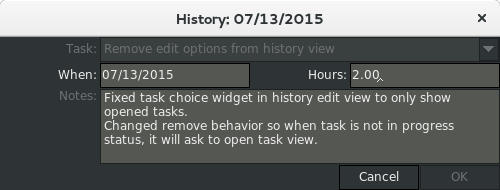
  • Added a task combobox in history view, so you'll know which task that history is refering too;
  • Changed remove button in history view to only remove history of tasks in progress. It will ask to open the task view otherwise;
  • Small fix to some parts where CoyoteTM was displaying Coyote TM;
  • Fixed spacing between menus and shortcuts; and
  • Merged canceled and completed view menu checkboxes to only "show all" now.
As usual, you can download it from sourceforge.
Enjoy!
History view now shows which task you are working on
You just have to ask

segunda-feira, julho 13, 2015

CoyoteTM 0.5 - now with history view

The last missing feature was finally added: history view. I don't know yet how things are going to be from now on because this is basically the end of what I was wishing for this application (ok, there is the gtk port yet... maybe).
Everything now is a big WHAT IF:
  • what if I port it to gtk?
  • what if I start to use sqlite?
  • what if I consolidate task / project / person and now history in only one main window?
  • what if I connect it to cloud services (dropbox, gdrive, box,...)?
While I'm thinking about that, other projects are just too late to start: a project management and a small business inventory / order management. They are all much bigger than this one and I hope to be able to dedicate more time to these things which means less series and movies and more coffee and code.

Ok, going back to CoyoteTM, this versions adds more than just the history view, here is a short list:
  • Fixed task list view buggy multiselection by dropping FL_DRAG event
  • Changed task list view sort to sort by category and then sort by status
  • Changed don't start task behaviour to open history but in read-only mode
  • Added read-only mode for task edit window when status is: ON HOLD, COMPLETED or CANCELED
  • Added history view
  • Added desktop file for DE integration, besides application icons
  • Improved about window
  • Added --version command line parameter
Get it while it is still fresh @ Sourceforge.
Finally, we can't miss a screenshot or two:
Glimpse of the new features: application icon, history view and new about window
Detail of the new history view
Oh, where am I running this gourgeus application? Fedora 22 with Gnome 3.16, thank you very much!

terça-feira, junho 16, 2015

CoyoteTM 0.4 - No GTK+ yet...

... and not anytime soon.

I'm learning GTK+, it's nice but it is not as easy as I first though. It's a weird way to develop OO. So far I didn't like it but that might change in the future.

I decided to focus on the code itself and I could do a few things better in FLTK like changing the border type globally and decreasing font size.

Here it is how it's now:
Task List

Task Edit


I also added sort by column header in all lists, added some field validation, improved the workflow a little bit and fixed some bugs. For more info, please check the change log.

I really enjoy working on this little project and it help me keep my stuff in order. Please feel free to reach me or to fill bug reports or feature requests. Thank you.

Download Coyote Task Manager

sexta-feira, fevereiro 08, 2013

JVM terminated. Exit code=160

Ok, I've got a new powefull T430 at my work: 8Gb memory and i5 (4 2.6Ghz cores) - very nice.

So, this was time for me to install a new Java Development environment. One of the good things you have by working for a software company is that you have access to all of its goodies. In my case, I've access to Rational and Websphere software.

In my current project we are using Rational Team Concert (RTC) 4.0 and as this version supports 64bits, I decided to give a try on the Rational Application Developer 8.5.1 64bits as well.

Yes, I'm running Linux at work - thank you very much.

All the install went well, downloaded the code I'm working on, but then suddently, when I tried to check-in a few changes, bazinga! JVM terminated. Exit code=160.

After some research (google as usual is your friend) I've found some related problems with XUL version, according to this IBM support post.

On my old setup (RAD 8.0) I had to apply that kind of fix, but instead I used this setup:
-Dorg.eclipse.swt.browser.UseWebKitGTK=true
in my eclipse.ini file.

So, I decided to try that fix here too. Done. Issue fixed.

sexta-feira, agosto 24, 2012

Linux Tutorial: How to Create a Shared Area

One problem I always had with me and my wife using the same computer was that sometimes we need to share things that are family related like photos, videos and stuff.

So on Linux, what do you do?

In my case, I created a commom user e.g. media. I also changed the user to not allow it to login because I don't need that (and because I can :)).

# cat /etc/passwd
media:x:1001:100:,,,:/home/media:/bin/false

# ls -l /home
drwx--x--x  83 media     users    12288 Ago 24 11:39 media

To make it fancy, I also created a group for that user and added me and wife to it.

# cat /etc/group
media:x:1001:me,mywife

# cat /etc/passwd
media:x:1001:1001:,,,:/home/media:/bin/false

# ls -l /home
drwx--x--x  83 media     media    12288 Ago 24 11:39 media

This was enough for me and my wife to start to share files, but we had another problem. Every time me or my wife moved a file there, the other one couldn't move the file around - like to categorize the photos inside subdirectories.

Another problem, all files we moved there continue with our user group and as I created an specific group for that I wanted to have it in that group (ok, not a problem, but oh boy, I want it).

To make files created on that directory to belong to media group was the easy one:

# chmod -R g+rws /home/media

Did you notice the 's' at the end of group permissions change? That does the trick of making sure that all files moved to that directory is going to be changed to the directory group instead of the users's group.

To solve the problem of me and my wife changing files the other one created on that directory I had to cry for help from ACL.

I won't explain what ACL is or isn't, so if you want more information about it, please google it. I'll just show you how I set it up.

First thing you need to mount your filesystem with ACL option enabled, then you can set the default permissions for an specific directory.

# cat /etc/fstab
/dev/sdb1 /home ext3 defaults,acl 0 1

# setfacl -R -dm g::rw /home/media

That's all. Enjoy!

quinta-feira, fevereiro 03, 2011

Save Some Space

Ok, sometimes you just need to save some space and you don't want to create an archive.

Or perhaps you have some kind of backup utility that for some reason doesn't do what you asked for and you need to unzip EVERY file it created in a n-level directory tree.

What to do now? Manually zip/unzip every single file? Take your last remaining hair off?

No, you use the shell find command. Period.

How? Simple. To compact every single file:

[me@mybox]$ find . -type f -print0 | xargs -0 /bin/gzip

To unpack all those files:

[me@mybox]$ find . -name "*.gz" -print0 | xargs -0 /bin/gunzip

Nice right?

Ok some explanations:

1) For both cases we use the find command (yeah) to... find and we pipe the results for xargs (ok, I won't explain what xargs does, so please: man xargs... come on I already helped you a lot here);
2) We use the option -print0 so it can understand we might have names with spaces or whatever other weird character in the file name, so it will quote the filename; and
3) On the first case (to compress) we only specify we want to compact all files of type "f" - file - so we exclude directories, symlinks and dwarfs;

That's it.

quinta-feira, dezembro 30, 2010

Nova postagem depois de muito tempo!!!

Fluxbox no Slackware (x86_64 current).

Para quem quiser nao ficar dependendo do gtk-chtheme, lxappearance,... basta colar isso no seu ~/.gtkrc-2.0:

# Uncomment your preffered gtk theme

#include "/usr/share/themes/Raleigh/gtk-2.0/gtkrc"
#include "/usr/share/themes/Xfce-4.0/gtk-2.0/gtkrc"
#include "/usr/share/themes/Xfce-4.2/gtk-2.0/gtkrc"
include "/usr/share/themes/Xfce-4.4/gtk-2.0/gtkrc"
#include "/usr/share/themes/Xfce-b5/gtk-2.0/gtkrc"
#include "/usr/share/themes/Xfce-basic/gtk-2.0/gtkrc"
#include "/usr/share/themes/Xfce-cadmium/gtk-2.0/gtkrc"
#include "/usr/share/themes/Xfce-curve/gtk-2.0/gtkrc"
#include "/usr/share/themes/Xfce-dawn/gtk-2.0/gtkrc"
#include "/usr/share/themes/Xfce-dusk/gtk-2.0/gtkrc"
#include "/usr/share/themes/Xfce-kde2/gtk-2.0/gtkrc"
#include "/usr/share/themes/Xfce-kolors/gtk-2.0/gtkrc"
#include "/usr/share/themes/Xfce-light/gtk-2.0/gtkrc"
#include "/usr/share/themes/Xfce-orange/gtk-2.0/gtkrc"
#include "/usr/share/themes/Xfce-redmondxp/gtk-2.0/gtkrc"
#include "/usr/share/themes/Xfce-saltlake/gtk-2.0/gtkrc"
#include "/usr/share/themes/Xfce-smooth/gtk-2.0/gtkrc"
#include "/usr/share/themes/Xfce-stellar/gtk-2.0/gtkrc"
#include "/usr/share/themes/Xfce-winter/gtk-2.0/gtkrc"
#include "/usr/share/themes/Xfce/gtk-2.0/gtkrc"
#include "/usr/share/themes/bubble/gtk-2.0/gtkrc"
#include "/usr/share/themes/qt4/gtk-2.0/gtkrc"

# gtk icon theme
gtk-icon-theme-name="Tango"


Simples, no primeiro bloco voce escolhe qual sera o tema e depois escolhe o tema dos icones. No caso do Slackware so tem um pre-instalado. Se instalar outro e so trocar esse dai.

Feliz Ano Novo!

quinta-feira, maio 24, 2007

Finalmente eu consegui instalar o meu roteador Wireless.
Agora estou chique.

quinta-feira, fevereiro 01, 2007

Compilação da Biblioteca Berkeley Db 4.5 no MinGW32.

É foi uma briga. Infelizmente não dá para utilizar apenas o pacote que a Oracle fornece porque na distribuição deles só vem a biblioteca C e se você quiser utilizar C++ vocês mesmo vai ter que compilá-la.

Bom, como eu já tinha a instalação do MinGW32, eu acabei tendo que instalar - apesar de não querer - o Msys para poder ter as ferramentas de desenvolvimento automake e autoconf.

Bom, agora vai uma dica, se você apenas seguir as intruções da documentação você não vai conseguir compilar a biblioteca porque no caso específico do MinGW32, é preciso ter mais uma biblioteca para compilação: wsock32.

Então para o processo de build funcionar, você deve fazer o seguinte:
$> cd db-4.5.20/build_unix
$> ../dist/configure --enable-cxx --enable-mingw LIBCSO_LIBS=-lwsock32 LIBXSO_LIBS=-lwsock32

Se você não adicionar essas duas variáveis no momento do configure, você pode acabar com o seguinte erro:
Creating library file: .libs/libdb-4.5.dll.a
.libs/os_errno.o(.text+0x3b): In function `_os_get_neterr':
c:/LibDB/build_unix/../dist/../os_windows/os_errno.c:57: undefined reference to `WSAGetLastError@0'
.libs/os_errno.o(.text+0x57):c:/LibDB/build_unix/../dist/../os_windows/os_errno.c:59: undefined reference to `WSASetLastError@4'
collect2: ld returned 1 exit status
make: *** [libdb-4.5.la] Error 1

Mais uma coisa que eu estava esquecendo. No Windows, ele acaba sobrescrevendo a biblioteca estática quando vai criar a biblioteca compartilhada. Se você quiser usar a biblioteca C++ estática, precisa impedir a criação da compartilhada, com o parâmetro --enable-shared=no do configure.

Boa sorte.

domingo, novembro 05, 2006

Finalmente consegui configurar o pppd para iniciar no boot.

O truque estava em colocar isso no arquivo /etc/network/interfaces:
pre-up /sbin/ifconfig eth0 up

Outra coisa, para evitar que a conexão ficasse caindo, eu comentei as seguintes linhas:
# The primary network interface
#allow-hotplug eth0
#iface eth0 inet dhcp

Para referência: Debian etch rodando speedy modem.